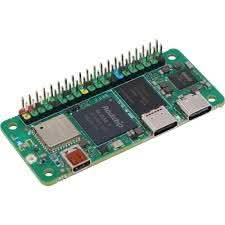
💥 Today, my plan was to explore the Raspberry Pi Zero 2W as a budget-friendly option. However, when I tested it practically, I found that its performance as an SBC (Single Board Computer) was extremely poor—essentially garbage. While it's good for robotics and AI applications, it is completely unsuitable for running a GUI (Graphical User Interface) based OS. It performs well in a CLI (Command Line Interface) environment, though.
While researching Raspberry Pi alternatives online, I came across the Radxa Zero 3W (or the Radxa Zero 3E if you need a 1GB RAM option on a lower budget). The 2GB variant of Radxa Zero 3W is thousands of times faster than the Raspberry Pi Zero 2W and is a great choice for running GUI-based applications. Additionally, it can be used as a hacking device due to its powerful hardware.
After comparing both boards, I found the Radxa Zero 3W to be significantly better and budget-friendly. So, I decided to go with it, and honestly, it was a great decision. If you're looking for a compact and powerful device, I highly recommend checking it out. Below, I have provided all the details 👇.
The Radxa Zero 3W is a high-performance Single Board Computer (SBC) designed for makers, IoT developers, hobbyists, and DIY PC enthusiasts. It offers a compact form factor with powerful hardware, making it a great alternative to the Raspberry Pi Zero 2W.
Key Features:
Processor (SoC): Rockchip RK3566
CPU: Quad-core Arm Cortex-A55 (ARMv8) 64-bit @ 1.6GHz
GPU: Arm Mali-G52-2EE, supporting OpenGL ES 1.1/2.0/3.2, Vulkan 1.1, and OpenCL 2.0
Memory Options:
1GB, 2GB, 4GB, or 8GB LPDDR4 RAM (depending on the variant)
Storage:
eMMC module support (optional)
MicroSD card slot
Connectivity:
Wi-Fi 5 (802.11ac) and Bluetooth 5.0
USB-C OTG + power input
USB 3.0 Type-A (only on some variants)
Display & Video:
HDMI output (4K@60Hz support)
MIPI DSI (for display interface)
MIPI CSI (for camera module)
Ports & Expandability:
40-pin GPIO header (similar to Raspberry Pi)
USB 2.0 and USB 3.0 ports (depending on the model)
Operating System Support:
Debian, Ubuntu, Android, Armbian, Manjaro, and other Linux distributions
Comments (0)
Be the first to comment!